
Understanding
Supplemental Testing for WGS/WES to Strengthen Genetic
Interpretations in Rare Disease and Unexplained Symptoms
While advances in whole genome sequencing and whole exome sequencing (WGS/WES) have greatly improved the ability to detect genetic variants related to rare diseases or unexplained symptoms, some genetic variants remain difficult to interpret. For some variants, this is due to a lack of available functional evidence and can lead to a missed diagnosis.
RNA sequencing (RNA-Seq) is a technology that is used as a supplemental test to provide additional information, revealing how changes in a gene’s DNA sequence impact gene activity and contribute to disease.
Expanding Role of RNA Sequencing in Clinical Diagnostics
10%
of the Undiagnosed Disease Network (UDN) have had RNA sequencing completed as part of their diagnostic work up.1
Several UDN studies have found RNA sequencing has diagnostic utility in both reclassifying variants and identifying variants that DNA testing algorithms did not prioritize.2
4%
of cases had at least one variant
that would benefit from RNA sequencing.3
Qualified variants were identified genes across a broad spectrum of disease impacting cardiac, neuromuscular, skeletal, renal, metabolic or head & neck organ systems.
Why RNA Matters
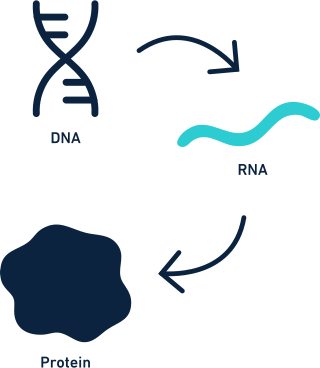
RNA is the functional bridge between genes and protein. It serves as an intermediary molecule, in the form of RNA transcripts, that carry instructions from a gene’s DNA sequence to guide protein production, which in turn drives cellular function.
Variants (changes) in a gene’s DNA sequence can alter the resulting RNA transcript which may ultimately affect protein expression and cellular function. By analyzing RNA sequences directly, we can better understand how genetic variants might impair protein production and contribute to disease.
Many disease-causing variants are believed to affect how RNA transcripts function, making RNA analysis an important tool to uncover the true impact of these findings.
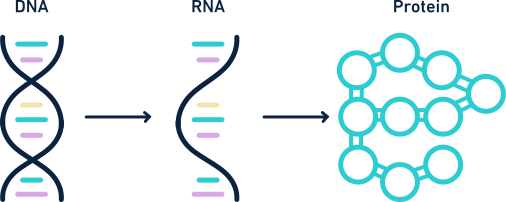
Typical DNA/RNA and Protein Function
The normal process where DNA information is used to create RNA, which then guides protein production essential for cellular function.
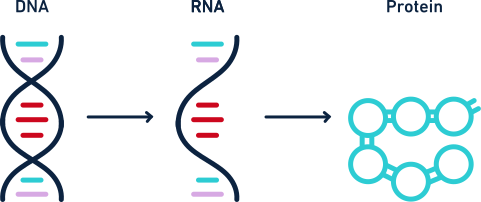
Altered DNA/RNA and Protein Function
Changes in DNA (red) can lead to altered RNA transcripts and abnormal proteins, disrupting normal cellular processes and contributing to disease.
Advantages of RNA-Seq
RNA-Seq helps strengthen genetic interpretations uncovered by WGS/WES results reported especially for patients with rare and complex conditions affecting numerous body systems.
Whole Genome Sequencing and Whole Exome Sequencing have diagnostic yield ranges of 27% to 43% and 24% to 37%, respectively, depending on the patient cohorts and clinical indication.
Clinical studies examining the diagnostic utility of RNA-Seq has demonstrated a diagnostic uplift of up to 7%. This can meaningfully increase the overall diagnostic yield in many cases.5-20
| Test without RNA-Seq | Diagnostic Yield Range* | With RNA-Seq |
|---|---|---|
| Whole Genome Sequencing | 27% – 43% |
Up To 7% Diagnostic
|
| Whole Exome Sequencing | 24% – 37% |
*Diagnostic yield varies across cohort and clinical indications.
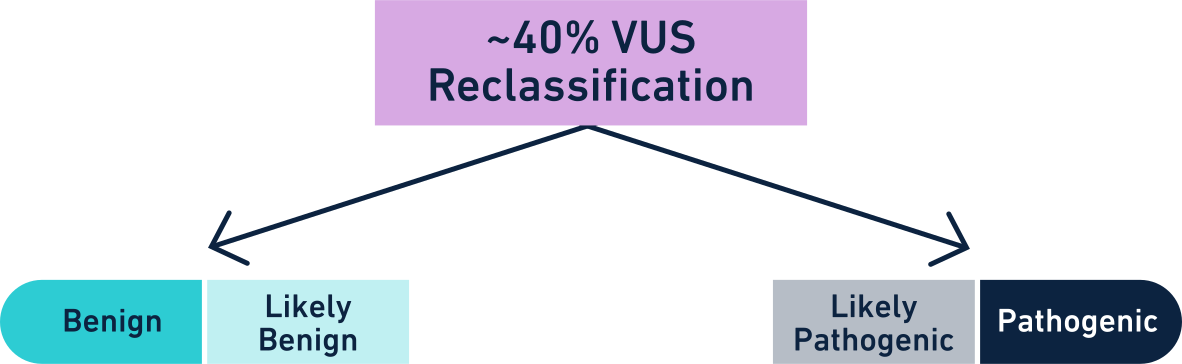
Variants of uncertain significance (VUS) are findings with uncertain clinical significance from genetic testing like WGS or WES, where it’s unclear whether a change in the DNA is linked to disease. Functional evidence about how RNA processing impacts downstream cellular function is often not available. RNA-Seq provides additional information about gene functionality in the body, helping clarify whether a variant is actually causing disease and potentially resolving the VUS results into a more definitive clinical classification.
Approximately 40% of qualified VUS are expected to be reclassified with RNA-Seq, helping providers make more informed diagnostic and care management decisions.3

Some genetic changes identified through WGS/WES testing are already suspected to cause disease but may benefit from functional evidence that supports clinical impact. RNA-Seq helps fill this gap by confirming how these variants impact gene function, strengthening diagnostic confidence and supporting clinical decision-making.
Not all genetic variants have much available data for interpretation from DNA testing alone. Many sit in non-coding regions that are often not captured by traditional DNA testing. RNA-Seq helps by showing how these variants impact the RNA transcript.
Noncoding Regions
(intronic regions)
Silent Mutations
These variants lie outside the coding parts of genes, where the impact is often unclear on WGS or WES tests alone.
These are changes in the DNA that don’t change the gene’s instructions in an obvious way, so they can be easy to overlook. But in some cases, they can still affect how the gene functions, and RNA sequencing can help reveal their impact.
Case Studies

Image representation. Not actual patient.
Patient Presentation: Pediatric male with ADHD, autism features, speech/language delay, facial dysmorphism, failure to thrive, brain findings (arachnoid cyst). No history of seizures. Presented with no prior genetic testing.
WGS Findings: Variant of Uncertain Significance in the CHD5 gene, known to be associated with autosomal dominant Parenti-Mignot neurodevelopmental syndrome (PMNDS).
PMNDS Features: Intellectual Disability, Epilepsy, Hypotonia, Speech/Motor Delay, Dysmorphia, Craniosynostosis.
Clinical Outcomes
RNA-Seq Findings: VUS finding was upgraded to Likely Pathogenic – RNA-Seq showed CHD5 gene was producing an abnormal RNA transcript, confirming the gene was not functioning correctly.
Diagnosis: Parenti-Mignot neurodevelopmental syndrome, consistent with developmental and neurological features.
Prognosis/Impact: RNA-Seq provided a clear answers in weeks – a diagnosis that might may have taken months or years to identify. Patient can now be proactively monitored for potential development of seizures and other features associated with PMNDS.

Image representation. Not actual patient.
Patient Presentation: Pediatric male with delayed speech and language development, motor delay, autistic behavior, hypotonia and EEG abnormality.
Multi-year diagnostic odyssey with negative genetic results (CMA and panel testing).
WGS Findings: Variant observed in the FOXP4 gene, was identified in the patient and inherited from the mother, who had a history of mild childhood developmental delays.
FOXP4 Heterozygous Variant Published Features: Developmental disorder, language delay, congenital anomaly.
Clinical Outcomes
RNA-Seq Findings: Variant was classified as Likely Pathogenic – RNA-Seq showed that the FOXP4 RNA transcript was missing part of exon 3.
Diagnosis: FOXP4-Related Neurodevelopmental Disorder consistent with patient’s features and a family history suggestive of mild or subclinical presentation.
Prognosis/Impact: RNA-Seq ended patient’s diagnostic odyssey and can now be enrolled in antisense oligonucleotide therapy.

Image representation. Not actual patient.
Patient Presentation: Pediatric male with global development delay, intellectual disability, hypotonia, seizures, brain structural anomalies and dysmorphic features.
Family history is positive for mother with borderline intellectual disability, dysplastic moles, and hypodontia.
WGS Findings: Variant observed in the PHF6 gene, known to be associated with X-linked Borjeson-Forssman-Lehmann (BFL) syndrome.
BFL Features: Intellectual disability, underdeveloped genitalia, truncal obesity, hypotonia, hypothyroidism (female carriers).
Clinical Outcomes
RNA-Seq Findings: Variant was identified as a silent mutation and classified as Likely Pathogenic impacting improper RNA transcript processing.
Diagnosis: Borjeson-Forssman-Lehmann (BFL) syndrome, consistent with developmental and neurological features.
Prognosis/Impact: RNA-Seq revealed a molecular diagnosis for the patient and his mother and improved treatment management.

How RNA Sequencing is Transforming Rare Disease Diagnosis
Dr. Christine Eng, MD
Chief Medical Officer and Chief Quality Officer at Baylor Genetics
1. Undiagnosed Diseases Network. Facts and Figures. UDN website. Published September 11, 2025. Accessed December 3, 2025.
2. PMID: 33001864
3. Internal Data
4. PMID: 28202748
5. PMID: 31694722
6. PMID: 29453418
7. PMID: 28567303
8. PMID: 28771251
9. PMID: 34570182
10. PMID: 29449963
11. PMID: 33935161
12. PMID: 29644095
13. PMID: 35842091
14. PMID: 28973083
15. PMID: 36064943
16. PMID: 34006472
17. PMID: 35701389
18. PMID: 37695591
19. PMID: 37236975
20. PMID: 31160820
21. PMID: 31607746