
Baylor Genetics
Supplemental Testing for WGS/WES
Strengthen Genetic Interpretations in
Rare Disease & Unexplained Symptoms
Clarify genetic findings to identify disease causes through targeted, patient-specific RNA analysis.
Advances in Whole Genome Sequencing (WGS) and Whole Exome Sequencing (WES) have greatly improved the ability to detect genetic variants related to rare diseases or unexplained symptoms, but some variants remain difficult to interpret. RNA sequencing analysis (RNA-Seq) helps strengthen the interpretation of variants identified by WGS/WES in patients who present rare and complex conditions with various clinical phenotypes. This supplemental test can help reclassify variants of uncertain significance (VUS) among other advantages.
Clinical studies examining the diagnostic utility of RNA-Seq have demonstrated a diagnostic uplift of up to 7%.1-17
| Test without RNA-Seq | Diagnostic Yield Range*,† | With RNA-Seq |
|---|---|---|
| Whole Genome Sequencing | 27% – 43% |
Up To 7%*,† Diagnostic
|
| Whole Exome Sequencing | 24% – 37% |
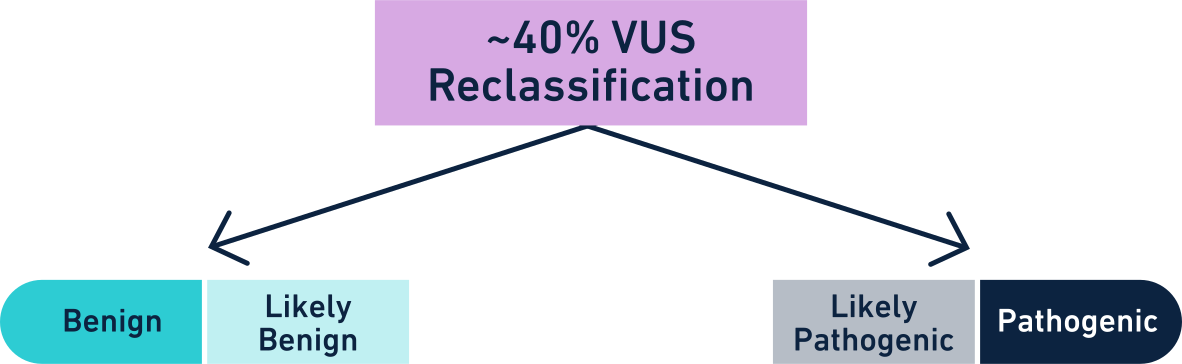
Variants of uncertain significance (VUS) are findings from genetic testing like WGS or WES where the clinical significance is conflicting or has incomplete evidence linking it to disease. Approximately 40% of qualified VUS are expected to be resolved into a more definitive clinical classification with RNA-Seq †18

Some genetic changes identified through WGS/WES testing are already expected to cause disease but may benefit from functional evidence that supports clinical impact. RNA-Seq helps fill this gap by confirming how these variants impact gene function, strengthening diagnostic confidence and supporting clinical decision-making.
Some genetic variants identified by WGS/WES are challenging to interpret – these include variants in coding and noncoding regions. RNA-Seq helps clarify the impact by showing how variants disrupt normal gene splicing (processing) and affect gene function.
Recognized Excellence in RNA Sequencing

2024 Biotech Breakthrough Award Winner
Overall Genomics Solution of the Year

2025 Digital Health Hub Foundation Awards Finalist
Best-in-Class Clinical Diagnostic Device: RNA-Seq

“By enhancing our Whole Genome and Whole Exome Sequencing tests with the addition of RNA sequencing, we increase the potential to re-classify uncertain variants and provide deeper understanding of a patient’s condition, treatment options and health management.”
Dr. Christine Eng, MD
Chief Medical Officer and Chief Quality Officer at Baylor Genetics
Designed Around The Patient Journey
By analyzing each genome/exome individually, we use advanced bioinformatics software to identify which variants are most likely disrupting gene function in specific patients. This patient-specific focus enables us to target the cause of disease sooner, guide RNA-Seq follow-up where it matters and deliver clearer, more confident answers without unnecessary steps.

Targeted RNA-Seq workflow: Initial WES/WGS results are reviewed to identify patient specific RNA-Seq-eligible variants, followed bytargeted RNA sequencine and generation of addended results.
*RNA-Seq is only performed on qualified variants that meet the prediction algorithm criteria that suggests additional functional evidence can be provided.
Variant Resolution: RNA-Seq may help resolve ambiguous WES or WGS findings —without waiting months or years for new research to emerge. This approach helps clarify findings by WES/WGS, ensuring timely and informed clinical decisions.
Simplified Sample Collection: In many cases, the blood collected for WES/WGS can also be used for RNA-Seq, allowing a single draw to support both analyses. The RNA-Seq workflow is validated for use with standard EDTA blood collection tubes. By using widely used EDTA tubes instead of test-specific PAXgene tubes, we reduce logistical challenges and enable easier integration into existing workflows. These tubes align with routine phlebotomy practices, minimizing the need for additional training or procedural changes.
Integrated Workflow*†: RNA-Seq is integrated directly into the WGS and WES workflows, minimizing placement of orders for this additional follow-up. This seamless integration delivers comprehensive genomic and targeted transcriptomic insights through a single, streamlined testing experience.
*RNA-Seq is only performed on qualified variants that meet the prediction algorithm criteria that suggests additional functional evidence can be provided.
†Providers have the option of opting in or out of RNA-Seq.
Combined Single Report: RNA-Seq is performed after initial WGS or WES results are reported, allowing for a customized, targeted analysis based on those findings. To streamline review and case management, Baylor Genetics issues an updated (addended) WGS/WES report if the RNA analysis provides new or actionable insights.
Testing Options
Available with Whole Genome Sequencing
- Proband WGS (Test Code 1810)
- Duo WGS (Test Code 1803)
- Trio WGS (Test Code 1800)
- Quad WGS (Test Code 1824)
- Rapid Proband WGS (Test Code 1829)
- Rapid Duo WGS (Test Code 1823)
- Rapid Trio WGS (Test Code 1822)
- Rapid Quad WGS (Test Code 1824)
Available with Whole Exome Sequencing
- Proband WES (Test Code 1500)
- Duo WES (Test Code 1603)
- Trio WES (Test Code 1600)
- Quad WES (Test Code 1604)
- Rapid Proband WES (Test Code 1729)
- Rapid Duo WES (Test Code 1723)
- Rapid Trio WES (Test Code 1722)
- Rapid Quad WES (Test Code 1724)
- Ordering Criteria: Add-on supplement test, ordered concurrently with WGS/WES for patients with suspected genetic disease.
- Not available as a standalone test.
- Sample Requirement: 1x EDTA tube per patient (3-5mL Whole Blood)
- Sample Inclusion Criteria: RNA-Seq performed on proband only, comparator samples not included
- RNA-Seq Turnaround Time: 28 days after initial WES or WGS results
More Information
RNA-Seq Qualification
RNA-Seq is only performed on qualified variants that meet the prediction algorithm criteria that suggests additional functional evidence can be provided. If a qualified variant is found by WGS or WES, RNA-Seq can only be performed on blood samples; if an additional sample is required to perform RNA-Seq, Client Services will reach out to the ordering provider.
CAP Accredited and CLIA Certified
The tests described have been developed and their performance characteristics determined by the CLIA-certified and CAP-accredited laboratory performing the test. These tests are laboratory-developed tests (LDTs) and have not been cleared or approved by the U.S. Food and Drug Administration (FDA). Clinical testing is performed in compliance with the Clinical Laboratory Improvement Amendments (CLIA) and the standards of the College of American Pathologists (CAP), ensuring high quality and reliability in laboratory practices.
†The performance characteristics shown for WGS, WES, and RNA-Seq are supported by peer-reviewed publications or representative data cohorts. These characteristics represent the general diagnostic performance of these tests, and may not specifically represent those from Baylor Genetics.
‡ Turn-around time can vary based on factors such as collection date, sample quality/quantity and completeness of patient information provided. RNA-Seq requires that the whole blood sample be less than 21 days at the time RNA-Seq is initiated.
*Diagnostic yield varies across cohorts and clinical indications.
It is important to understand that genetic tests, even if negative, cannot rule out every variant. Genetic testing, while highly accurate, might not detect a variant present in the gene(s) tested. This can be due to limitations of the information available about the gene(s) being tested, or limitations of the testing technology. It is not possible to exclude risks for all genetic diseases for patients or their family members. It is possible that even if the test identifies the underlying genetic cause for a disease, this information may not help in predicting the progression of disease or change management or treatment of disease.
1. PMID: 31694722
2. PMID: 29453418
3. PMID: 28567303
4. PMID: 28771251
5. PMID: 34570182
6. PMID: 29449963
7. PMID: 33935161
8. PMID: 29644095
9. PMID: 35842091
10. PMID: 28973083
11. PMID: 36064943
12. PMID: 34006472
13. PMID: 35701389
14. PMID: 37695591
15. PMID: 37236975
16. PMID: 31160820
17. PMID: 31607746
18. Based on Internal Data